
Downspouts & Roof Drainage in Torrance, CA
- 4.8★ from 73 Google reviews
- Free estimates
- Same day or next day service
- Photos of what we find
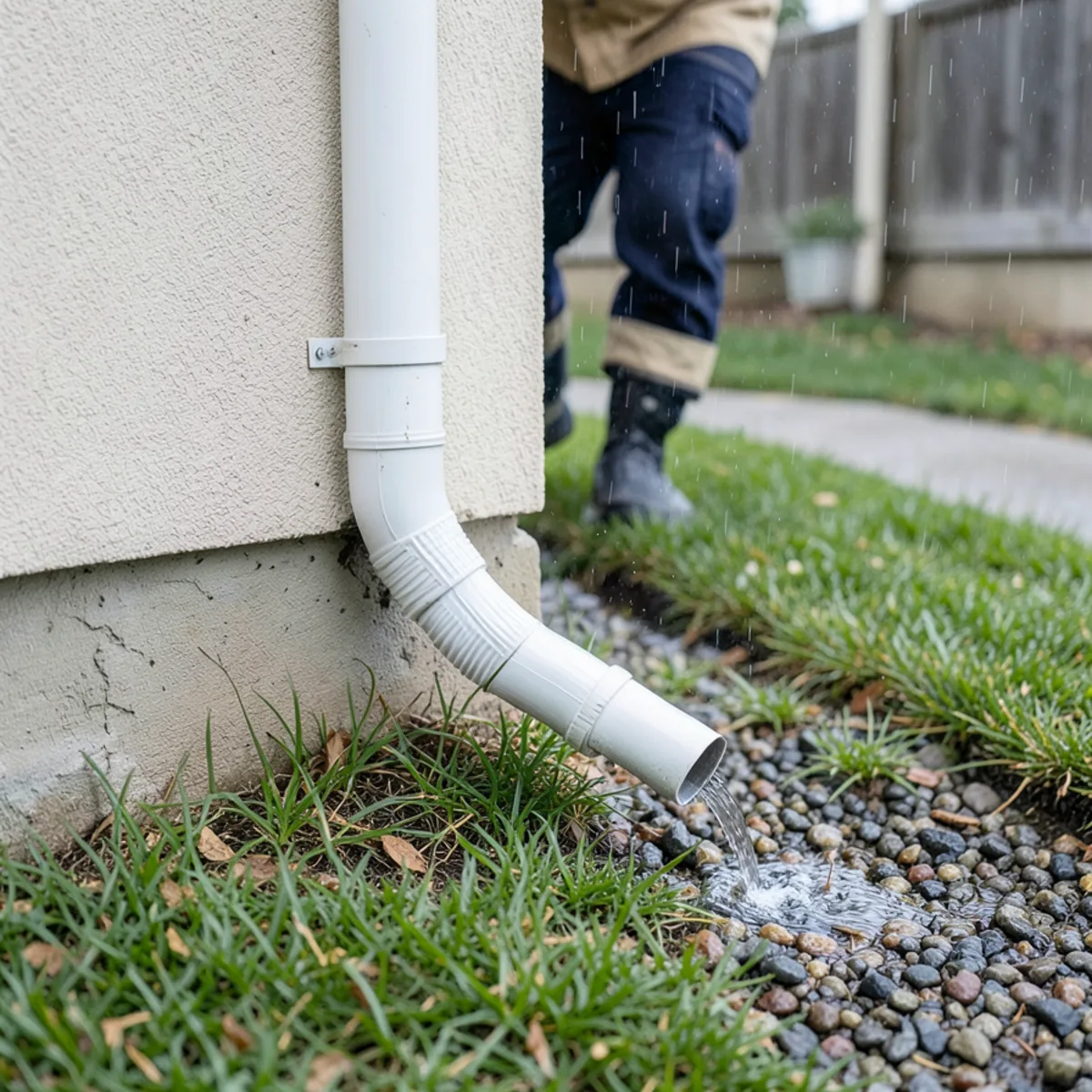
A gutter collects water. A downspout moves it. A drainage plan decides where it ends up. When the last step is missing, water pools at the foundation, runs onto a neighbor's lot or soaks a planter against the stucco. This page covers the part of the roof drainage system that starts where the gutter ends. It is part of our gutters and fascia work, and it connects to fascia, soffit and roof trim and gutter installation.
Why does a downspout installation in Torrance often matter more than the gutter?
Because the downspout decides whether the system works at all. A perfect gutter with one downspout at the end of a 60-foot run will overflow in a hard storm. A well-placed downspout with a short extension keeps water off the foundation line.
Torrance gets most of its 14 inches of rain in short, hard bursts between November and March. Stucco and the soil beside the footing take in whatever lands there. Water that sits at the base wicks into the plaster base, stains paint and can erode the soil beside the footing.
What does downspout repair and installation include?
A downspout visit covers more than the pipe. We walk each corner and outlet, trace where the water lands now, and photograph the stains, splash marks and soft soil that show a problem. Signs worth watching for: a dark band on the stucco at the base, mud splashed above the paint line, a patio slab that has settled toward the wall, a planter that stays wet after the rain stops, or a gutter that overflows at one end only. Any of those points to a missing, undersized or badly placed downspout. The scope usually includes:
- Adding or relocating a downspout, with a new outlet cut and sealed in the gutter.
- Replacing crushed, rusted or sun-cracked sections and elbows.
- Strapping each drop to the wall so wind or a ladder does not pull it loose.
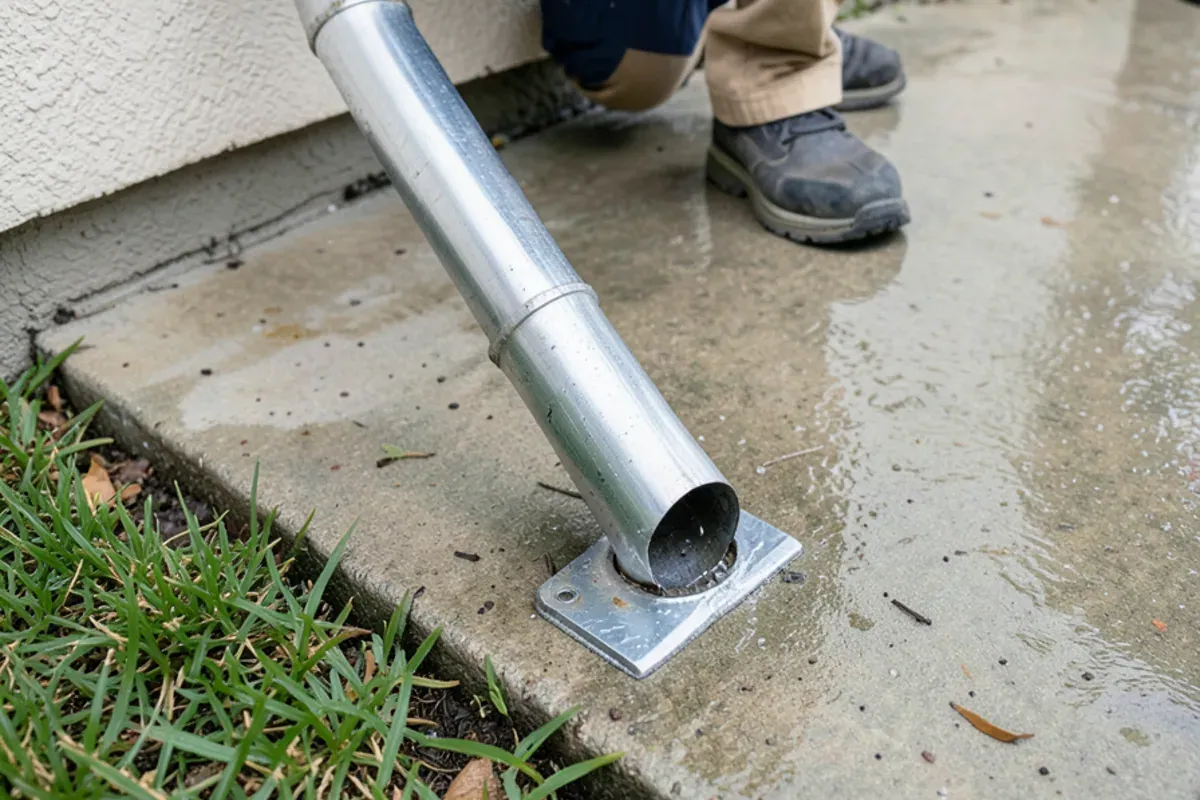
- Fitting rigid extensions, splash blocks or a buried line to the discharge point.
- Cleaning out and testing flow with water.
- Cleanup, with landscaping and driveways protected.
Common problems and fixes:
- Loose or detached downspouts. Re-strap to the wall with new brackets.
- Crushed or dented sections. Replace the damaged piece rather than patch.
- Leaking joints. Re-fasten and seal the elbow or seam.
- Clogged downspouts. Flush with water and clear what is stuck, as in gutter cleaning.
- Missing elbows or extensions. Add them so water leaves the wall zone.
- Outlets pulling out of the gutter. Re-cut and reseal the outlet.
How does a roof drainage system get planned?
We work from the roof down:
- Divide the roof into drainage areas. Each slope, valley and section feeds a particular gutter run.
- Match capacity. Gutter size and downspout size should handle the water from each area.
- Place outlets. Downspouts go where water can leave without crossing a walkway, door or neighbor's property.
- Plan discharge. Splash blocks, extensions, underground drains or dry wells, depending on the lot.
- Check the ground. Soil should slope away from the foundation.
When is an underground downspout drain a better choice?
An underground drain is a buried pipe that takes downspout water to the street, a drain inlet or a dispersal spot farther from the house. It makes sense when:
- The lot is flat with no place for surface discharge.
- A walkway, patio or driveway crosses the water path.
- Several downspouts empty to the same corner.
- Extensions would be a trip hazard.
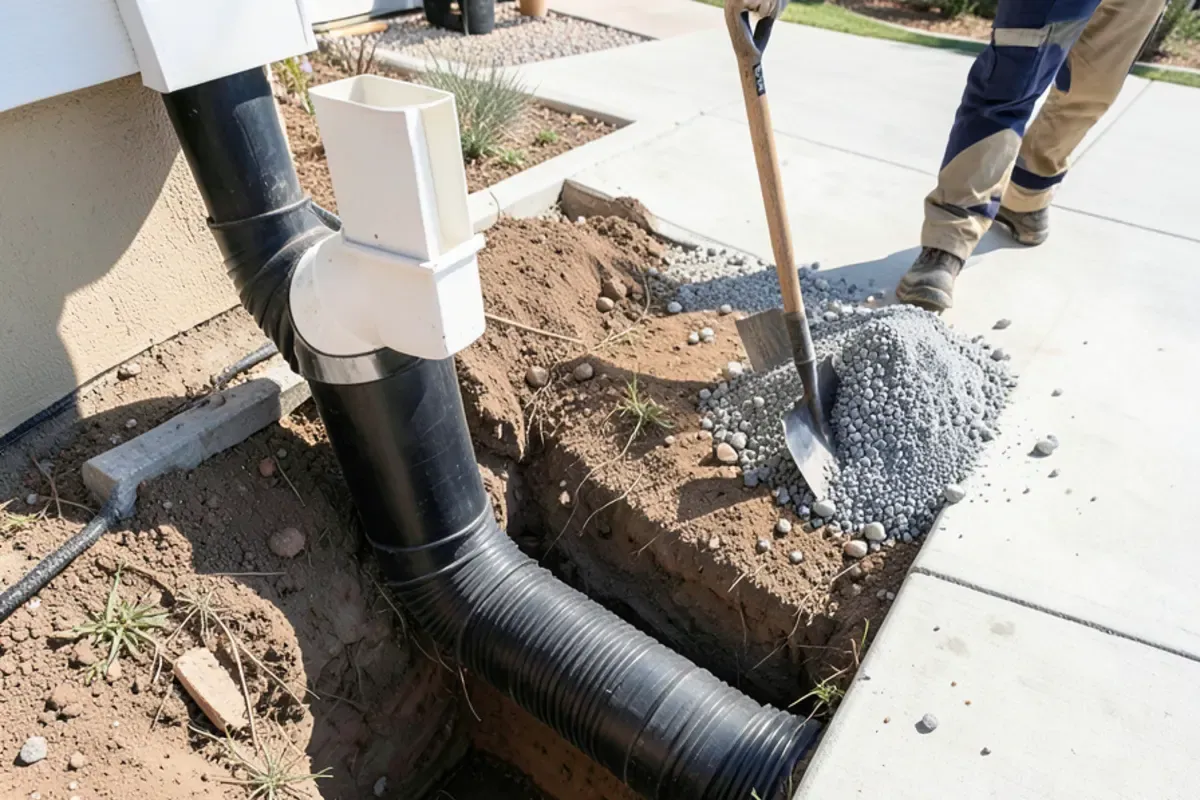
The pipe has to slope, stay clear and exit somewhere allowed. Local rules on street discharge vary, so we suggest you confirm the destination with the City of Torrance Building & Safety at (310) 618-5910 for your address. Foundation drainage from gutters matters most on hillside lots, where runoff has a long way to go.
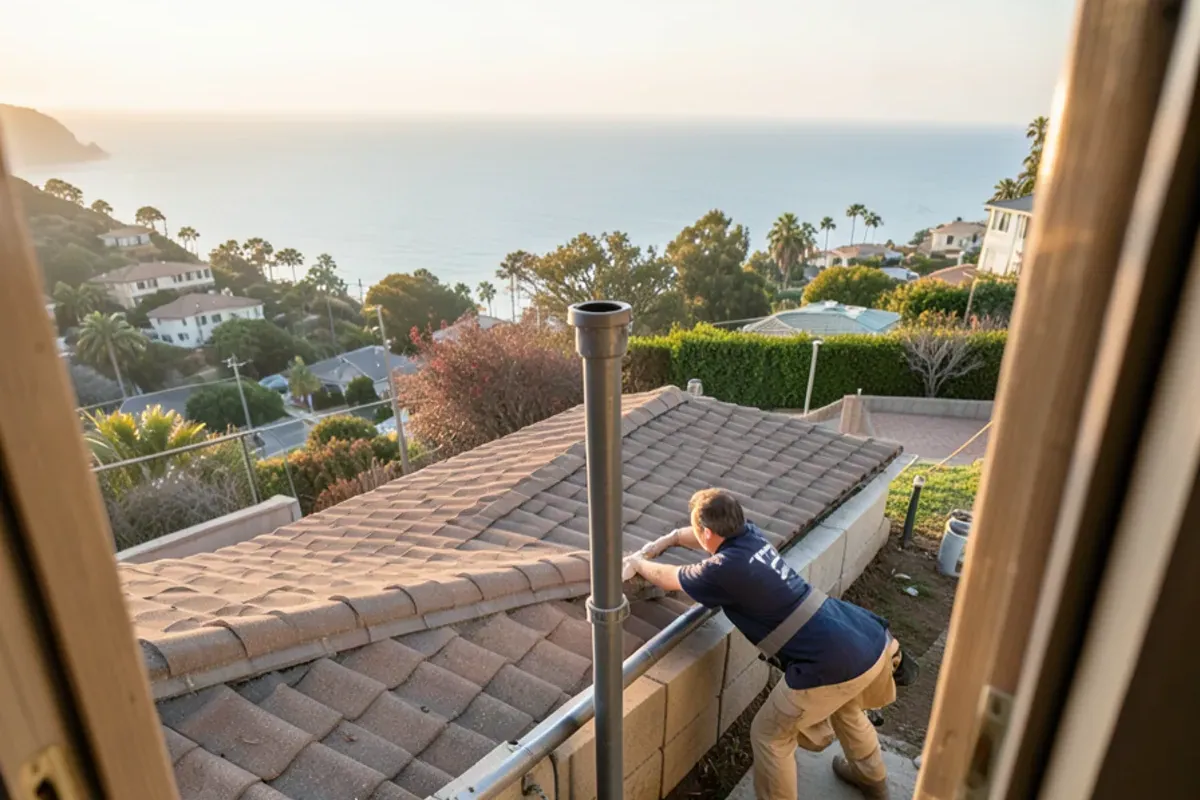
How do flat roofs drain, and what are scuppers and roof drains?
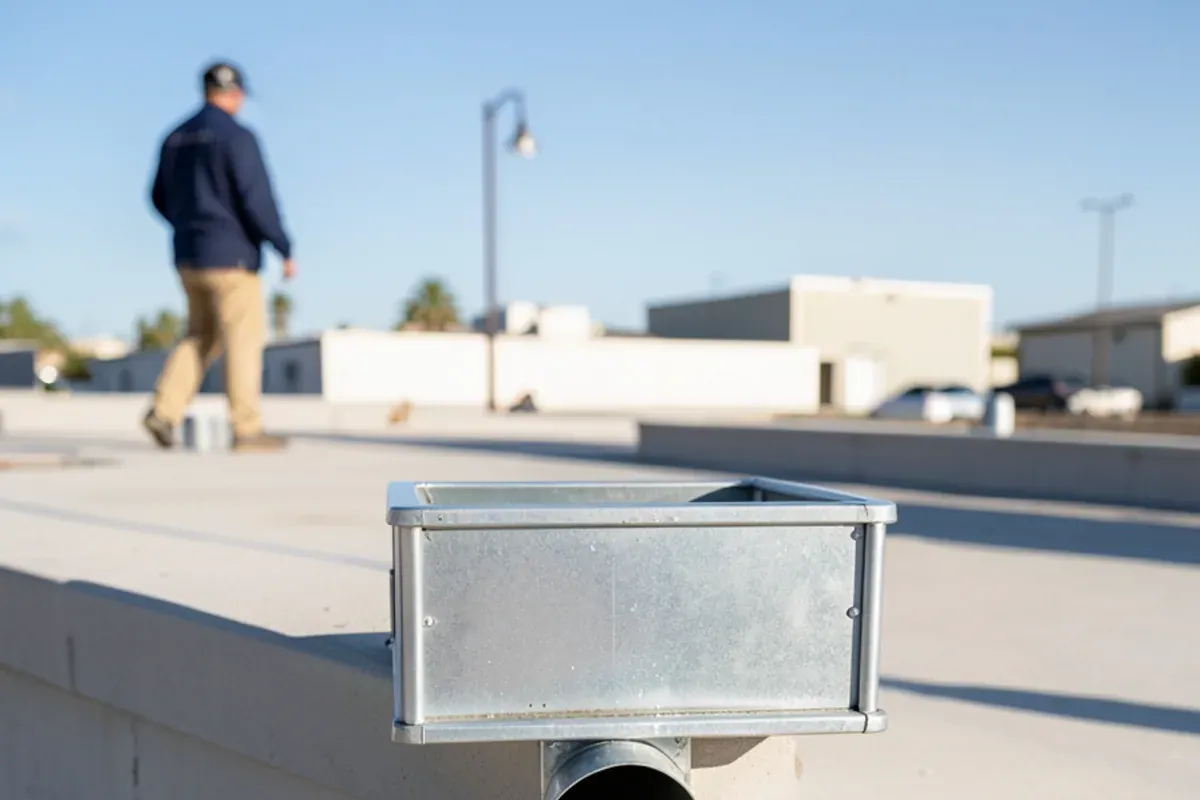
Flat and low-slope roofs have no gutters in the usual sense. Water is meant to run to a drain in the roof surface or out through a scupper in the parapet wall, then down a downspout. If the drain is blocked, the opening is too small, or the roof has low spots, water ponds. Ponding adds weight and wears the membrane.
Roof drain repair means clearing and re-sealing the drain bowl, checking the membrane around it and replacing strainers or leaders. Adding a scupper means cutting a controlled opening and flashing it. See our flat roofing services for membrane work.
Which downspout sizes and materials, and what changes the price?
Most residential downspouts are rectangular aluminum, in a smaller and a larger size, and round versions exist for custom looks. The larger size moves more water and clogs less often, so we use it on big roof areas and on 6-inch gutters. Steel can dent and rust, copper is a design choice and plastic extensions fade and crack in strong sun. At the ground, we prefer a rigid extension or buried line to a floppy corrugated hose that kinks and gets stepped on. Whatever the material, each downspout is strapped to the wall so a gust or a ladder does not pull it loose.
We give free estimates and do not post prices. The factors are the number of downspouts, the height, the pipe size, whether an underground line is needed and how long it runs, the surface it has to cross (soil, concrete, pavers), and any flat roof penetrations or flashing. Adding an extension is a small item. A buried drain is not.
Which permit rules and licensing decide where downspout water can go in Torrance?
The destination matters as much as the pipe. Water that leaves your lot can end up on a neighbor's property, a public sidewalk or the street, and the rules on curb or storm drain discharge depend on the address. Call City of Torrance Building & Safety at (310) 618-5910 before you run a buried line to the street. Unincorporated areas use LA County Public Works instead, and the City of LA uses LADBS. In mapped Very High Fire Hazard Severity Zones, California Building Code Chapter 7A requires noncombustible downspouts, according to City of Los Angeles and LA County plan-check notes. Check any contractor's license on the CSLB website.
Why Crown Trim for downspouts and drainage?
- We are a roofing company, so we look at where the roof sheds water, not only the pipe.
- Photos of where your water lands now, and a plain explanation of the fix.
- Free estimates and free roof inspections.
- Same day or next day service for urgent water problems.
- Thorough cleanup, protecting landscaping and driveways.
- A repair first when a repair will do, such as an extension or a new strap before any new pipe.
- A 4.8-star rating from 73 Google reviews.
Where we work on drainage
We plan drainage across the South Bay. In Carson, flat lots often need extensions or buried lines. Redondo Beach has tight side yards where a downspout has only a few feet to work with. On the Rancho Palos Verdes hillsides, slope and drop-offs decide where water can go safely.
Where we do downspouts & roof drainage around Torrance
Each place brings its own version of this job.
- Hawthorne: Small 1950s apartment buildings on flat or low-slope roofs need scuppers and roof drains cleared and sized, with downspouts squeezed into narrow side yards.
- Gardena: Low-slope commercial buildings on small industrial lots rely on scuppers and drain leaders, beside post-war homes that need extensions.
- Marina del Rey: HOA-managed condo and apartment flat roofs on county-leased land, where roof drains and leaders have to work in constant marine air.
- Vernon: An industrial city where food-processing, cold-storage and warehouse roofs are the whole market, and large flat roofs depend on drains and scuppers.
- Cudahy: Long, narrow lots where one parcel holds several dwellings and several separate roof sections, each needing a place to discharge.
- Maywood: Compact older homes on tight lots with little room, so buried lines and short extensions often replace surface discharge.
- Monterey Park: Hillside subdivisions with low-pitched roofs on slopes, where downspout runoff needs a controlled path downhill.
- Signal Hill: Hilltop condos and townhomes where wind and slope decide how water can leave the roof edge safely.
- West Rancho Dominguez: Homes beside warehouses near Rosecrans, mixing older composition houses with low-slope commercial roofs that drain through scuppers.
- North El Monte: Ranch homes in this small unincorporated area need downspouts that carry runoff well away from the foundation, and county permits apply to larger work.
What customers say about this work
Crown Trim Roofers holds 4.8 stars from 73 Google reviews. Read all reviews
“Crown Trim Roofers did an excellent job with the gutter installation at the back of my home and adding gutter guards to the front gutters.”
“Part of the shingle line had been left too short near the edge, which exposed the wood and caused a long section of fascia board to rot.”
“The full roof installation took only a few days, and they made sure the area was cleaned up well after the work was finished.”
Downspouts & Roof Drainage: common questions
How many downspouts does a Torrance home need?
It depends on roof area and gutter length, not a fixed number. A common rule of thumb is one downspout for every 30 to 40 feet of gutter, and sooner if the roof is large, steep or has valleys draining into one spot. Many older homes here have too few. We count your runs and slopes at the estimate and place the downspouts accordingly.
Can you add a scupper or drain to a flat roof?
Yes. A scupper is an opening in a parapet wall, and a drain sits in the roof surface. Either one lets water out where it pools. Cutting into a roof and parapet needs flashing and waterproofing around the new opening so it does not leak. We check slope first, since a scupper only helps if water can reach it. See flat roof repair.
Where should my downspouts discharge?
Away from the foundation, onto ground that slopes away from the house, onto a splash block, an extension or into a drain line. Avoid dumping onto a neighbor's property, a walkway or a planter against the wall. A few feet of extension fixes most problems. Where space is tight, an underground line to the street or a drain is the better choice.
Can a downspout be moved or added without redoing the gutter?
Usually, yes. A new outlet can be cut into an existing gutter and the run re-sloped toward it. Whether it makes sense depends on the gutter's age. If the metal is worn, we may suggest gutter installation instead of cutting into an aging gutter. We tell you which approach costs less over time.
Why does water collect at one corner of my house after rain?
Often a downspout is emptying right there, or two roof slopes are sending water to the same spot. Water can also be running behind an undersized gutter and dripping down the wall. We trace the source, then add a downspout, extension or drain so the water has somewhere to go.
Related services and guides
Fascia, Soffit & Roof Trim
Gutter Installation
How Much Do New Gutters Cost in Torrance?
Fascia Rot Behind Gutters: Causes and Repairs
How Often Should You Clean Gutters in Torrance?
Where we work: Carson, Redondo Beach, Rancho Palos Verdes, Gardena and the rest of our service areas.
Water pooling by the foundation? Fix the discharge point.
Call first. A roofer picks it up from there.