
By the Crown Trim Roofers team · Published · Updated
Search "cool roof" in Los Angeles County and you will find rules that seem to disagree. They are not contradictions. They come from different authorities, and each one covers a different set of addresses. If you are planning a cool roof installation, sorting out which authority governs your house comes first.
What is a cool roof, and why does the code care?
A cool roof reflects more sunlight and sheds the heat it absorbs more efficiently than a conventional roof. That lowers the surface temperature, which reduces heat flowing into the attic and eases air-conditioning load. Cool roofs come in many colors. The relevant numbers are solar reflectance and thermal emittance, and some codes combine them into a Solar Reflectance Index.
The code cares because large areas of dark roofing add to urban heat. California treats roof surfaces as part of the building's energy performance.
Which rules apply to a re-roof in LA County?
There are three layers.
- State energy code. The California Energy Commission's Title 24, Part 6 sets cool roof provisions for re-roofs. They depend on slope, climate zone and the share of the roof replaced. Published city and utility guides describe the requirement as triggered at around half of the roof, with some exceptions for steep-slope roofs. The exact trigger and exceptions for your house are a question for your building department.
- City of Los Angeles. The city's cool roof ordinance made cool roofing mandatory for new and replacement residential roofs. Enforcement phased in and reached full effect in 2015. Los Angeles permits run through LADBS.
- Unincorporated LA County. Parcels outside any city use the county's green building code and permit system, run by LA County Public Works Building and Safety. Individual cities elsewhere in the county follow their own codes, so always check the city.
Torrance and the other South Bay cities enforce the state energy code and any local amendments through their own building departments.
What changed in the 2025 Energy Code for re-roofs?
The 2025 Energy Code applies to permit applications filed on or after January 1, 2026. The structure for a residential re-roof is familiar. Cool roof provisions apply when more than 50 percent of the roof is replaced. Steep-slope and low-slope roofs have separate rows, and each row lists the climate zones where it applies, so the same product can be required in one zone and not in another. Products must carry a CRRC label, and a product without one is assigned a low default reflectance, which is why an unlabeled shingle rarely passes review.
The California Energy Commission offers a climate zone lookup by address or ZIP code. Cities that publish a compliance form for 2025 residential re-roofs name it CF1R-ALT-01-E. Cities and counties can also adopt local rules that go beyond the state minimum, so the state summary is a starting point and not the final answer.
How do slope and building type change the answer?
Slope is the biggest split. Low-slope roofs (a rise of less than 2 in 12) and steep-slope roofs are treated separately, and values for each differ. Low-slope roofs also bring insulation questions in many climate zones. Building type matters too: residential, high-rise residential and non-residential buildings sit in different sections of the code.
We will not quote a number for your house here, because the answer depends on your slope, climate zone and roof area, and the codes get revised. What we can do is explain the pieces so you ask better questions.
| Question for your building department | Why it matters |
|---|---|
| What share of the roof counts as replaced? | It decides whether the cool roof rule is triggered. |
| Is the roof steep or low slope? | Reflectance and emittance targets differ. |
| Which climate zone is the address in? | Some zones carry stricter provisions. |
| Which exceptions apply, such as attic radiant barrier or insulation? | Some steep-slope roofs qualify for an exception. |
| What documents are required? | Permit files may need product ratings and compliance forms. |
Which exceptions do homeowners ask about most?
Published summaries of the 2025 code list several. Your building department decides which ones apply:
- Ceiling insulation at a stated level, or a radiant barrier in the attic, can count as equivalent for some steep-slope roofs.
- Some climate zones accept a house with no ducts in the attic.
- Continuous insulation above or below the roof deck can count.
- Roof area covered by building-integrated solar panels is not held to the reflectance values.
- Roof constructions that weigh at least 25 pounds per square foot are exempt.
If the entire deck over a ventilated attic is replaced, neighboring cities also ask for one of a short list of insulation and radiant barrier items. That list is where many re-roof budgets pick up a surprise, so ask early.
What if you only replace part of the roof?
Partial re-roofs are where homeowners get surprised. The title 24 cool roof provisions, and the city and county versions of the LA cool roof ordinance, usually key off how much of the roof is being replaced. Replacing one slope over a bad leak may sit below the trigger. A larger section may cross it. Do not split a job on paper to dodge the rule, because inspectors compare the permit scope with what is on the roof. Ask the department how it counts area and what proof it wants. Our post on Torrance re-roof permits and Title 24 walks through the same question for a South Bay city, and it applies to the roof energy code in general.
How does the Los Angeles Green Building Code differ from the state code?
The City of Los Angeles runs its own green building code on top of the state energy code. The Cool Roof Rating Council's summary shows that it sets Solar Reflectance Index targets for low-rise residential roofs, with separate targets for low-slope and steep-slope roofs. The city ordinance that made cool roofs mandatory in 2015 sits alongside it. LADBS issues the permit and checks the paperwork, so a Los Angeles address gets its answer there, not from the state summary alone.

What are reflective shingles?
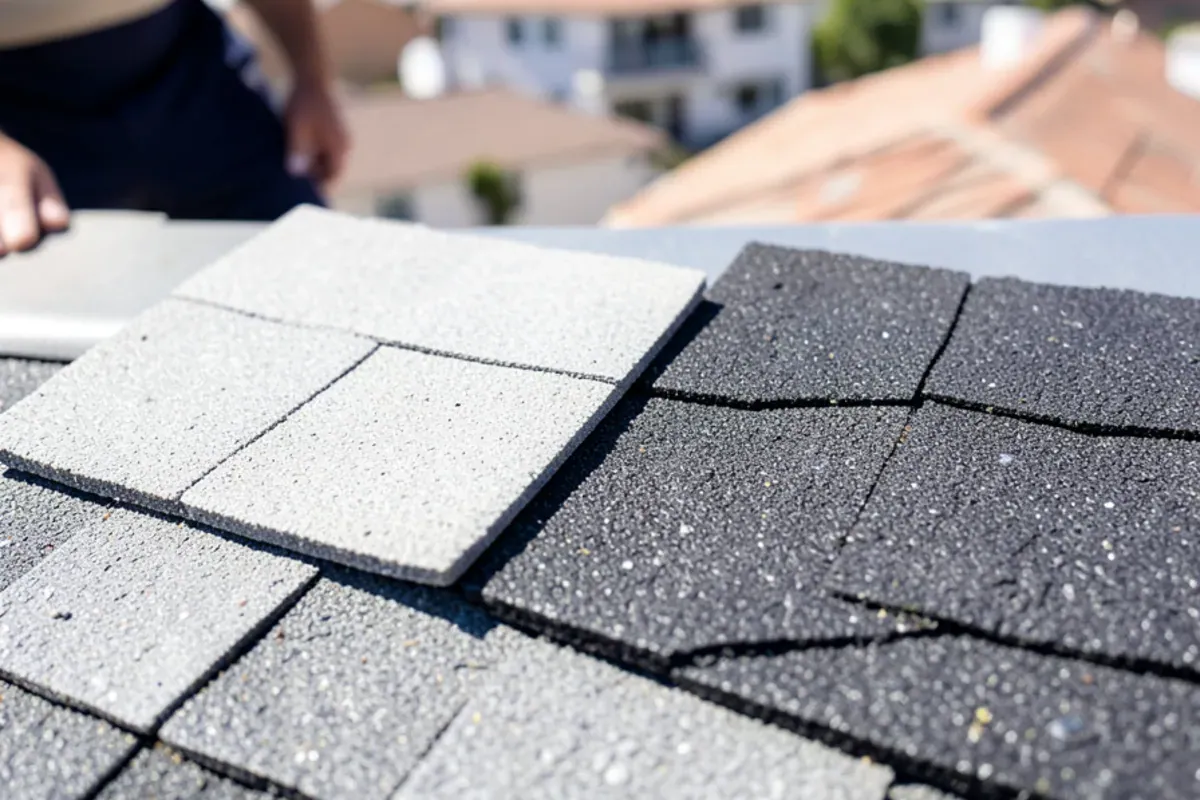
Reflective shingles are asphalt shingles with granules that reflect more of the sun. Some have a CRRC listing that meets typical requirements, and some do not. Color alone is not a guide. Ask for the CRRC product ID and check the directory. Our roof replacement overview explains how material choices tie into the rest of the job.
Is there a cool roof rebate?
Sometimes. LADWP has offered residential cool roof rebates tied to a product's 3-year SRI, and eligibility is for LADWP electric customers. LADWP's 2024 fact sheet advertised up to $0.60 per square foot, with limited funding, no guarantee and the right to change the program. Amounts and rules change, so check LADWP's program page before you buy. Customers of other utilities need to ask their own utility about programs. Do not assume a rebate exists, and do not assume a roofer can claim it for you.
What roofers tell customers about cool roofs
Here is what we check and say:
- We ask your address first, since the answer starts with the building department that covers it.
- We bring shingle samples and explain which have CRRC listings, so you can compare color and rating.
- We explain the difference between a requirement and a nice-to-have in plain terms.
- We tell you when a repair will do. A small repair is not a cool roof trigger the way a major replacement can be.
- We handle permit details on re-roofs and note the product information for the file.
Before you pick a roof color
Call the building department for your address and ask the five questions in the table. Then ask your roofer for the CRRC product ID of anything on the estimate. Crown Trim Roofers offers free estimates and can walk your roof, show you what is up there, and explain your options.
Sources
- California Energy Commission: Building Energy Efficiency Standards
- BayREN: Residential Roofing, Guide to 2022 Energy Code Requirements
- Cool Roof Rating Council
- City of Los Angeles Ordinance No. 183149: Cool Roof
- LADWP Cool Roof Rebate Program
- LA County Public Works Building and Safety
- Cool Roof Rating Council: 2025 California Energy Code cool roof summary
- Cool Roof Rating Council: Los Angeles Green Building Code
- City of Rancho Palos Verdes: Reroofing cool roof requirements handout
- LADWP: Consumer Rebate Program fact sheet