
By the Crown Trim Roofers team · Published · Updated
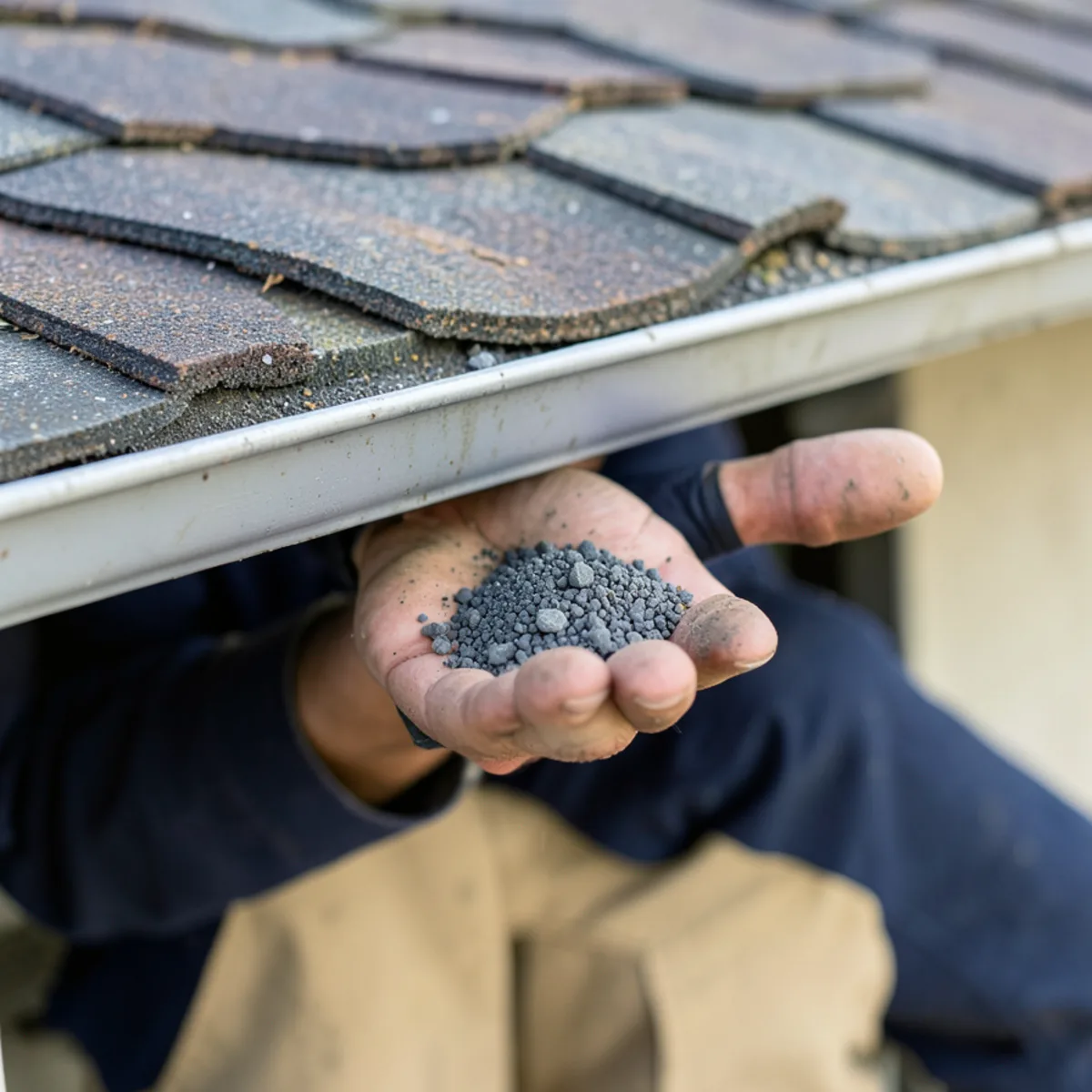
Open a gutter on an older house and you will often find a layer of dark grit at the bottom. It looks like pepper, and it came off your shingles. This post belongs with our roof repair guides. If you already know a few shingles need work, our shingle roof repair page explains how that goes. Here we cover what granule loss means.
What do shingle granules actually do?
Granules are crushed mineral stone pressed into the top of an asphalt shingle. They give the shingle its color, and they protect the asphalt below from the sun. They also add some fire resistance and help the shingle shed water.
The asphalt layer is the waterproofing. Without granules on top, ultraviolet light and heat break it down, and the shingle dries, cracks and curls. Granule loss is the roof wearing away its own sunscreen.
When is granule loss normal?
Small amounts are fine in two cases.
- On a new roof. New shingles shed loose granules for the first few months. That is a normal part of settling in.
- On an aging roof after a rain. A roof that is many years old sheds a little with every storm.
If you see a light dusting in the gutter, a few granules in the downspout elbow or a trace on the ground by the downspout, you are likely looking at ordinary wear.
How can you test your own gutter?
A ten-minute check beats guessing from the ground. Do it on a dry day.
- Photograph the gutter bottom near each downspout before you touch anything.
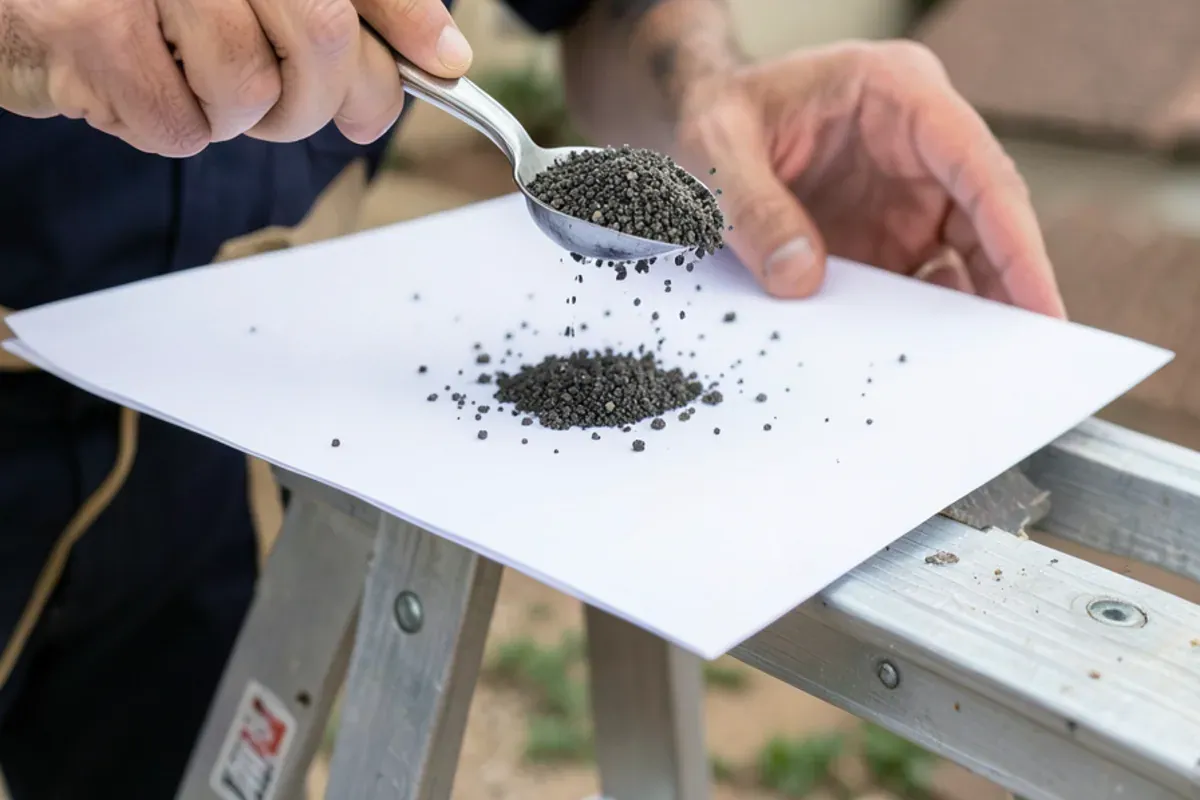
- Scoop one handful of grit and spread it on a sheet of white paper.
- Note the color and size: dark gray round grains are granules, while tan sand-like grit may be mortar or tile dust.
- Compare the pile at the downspout nearest a sunny slope with one under a shaded slope.
- Repeat after the next two storms. A pile that keeps coming back means shedding is continuing.
- Look at the roof from the ground with binoculars for bald or dark patches on the same slope.
When is it a warning?
Look for these patterns.
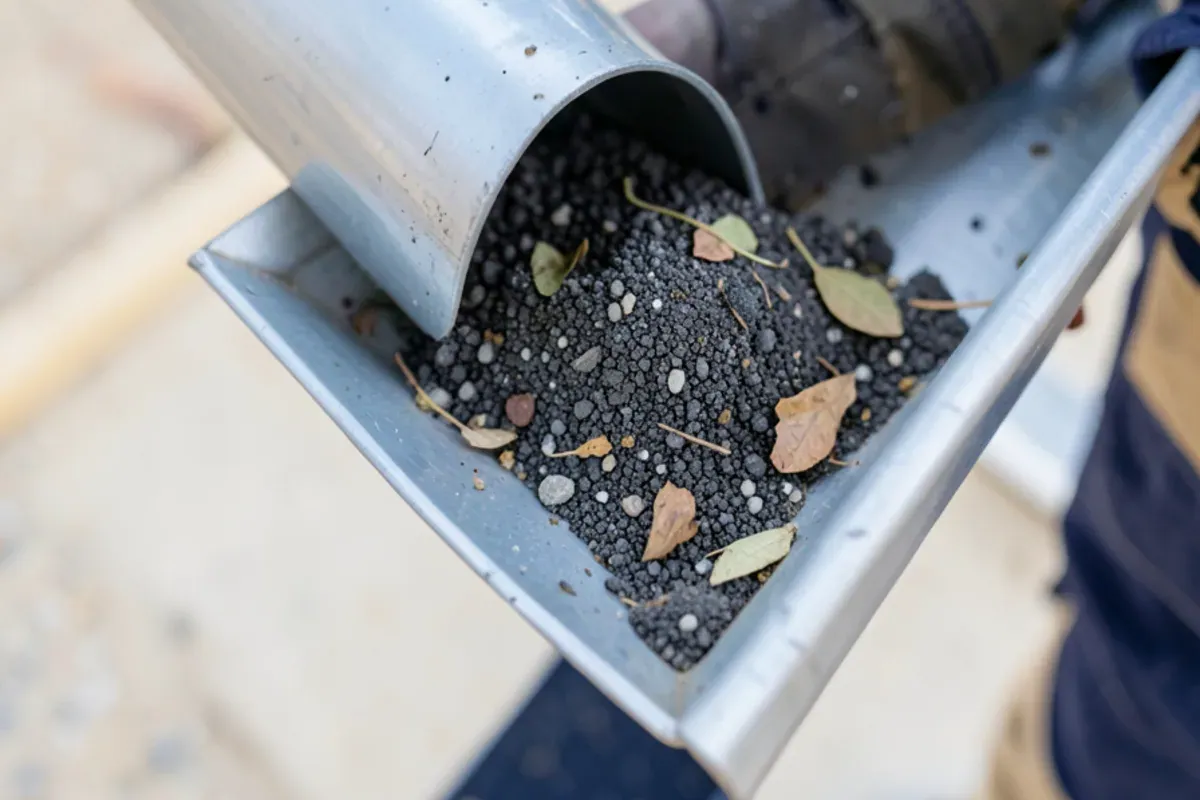
- A thick layer at the downspout outlet. Handfuls, not a pinch.
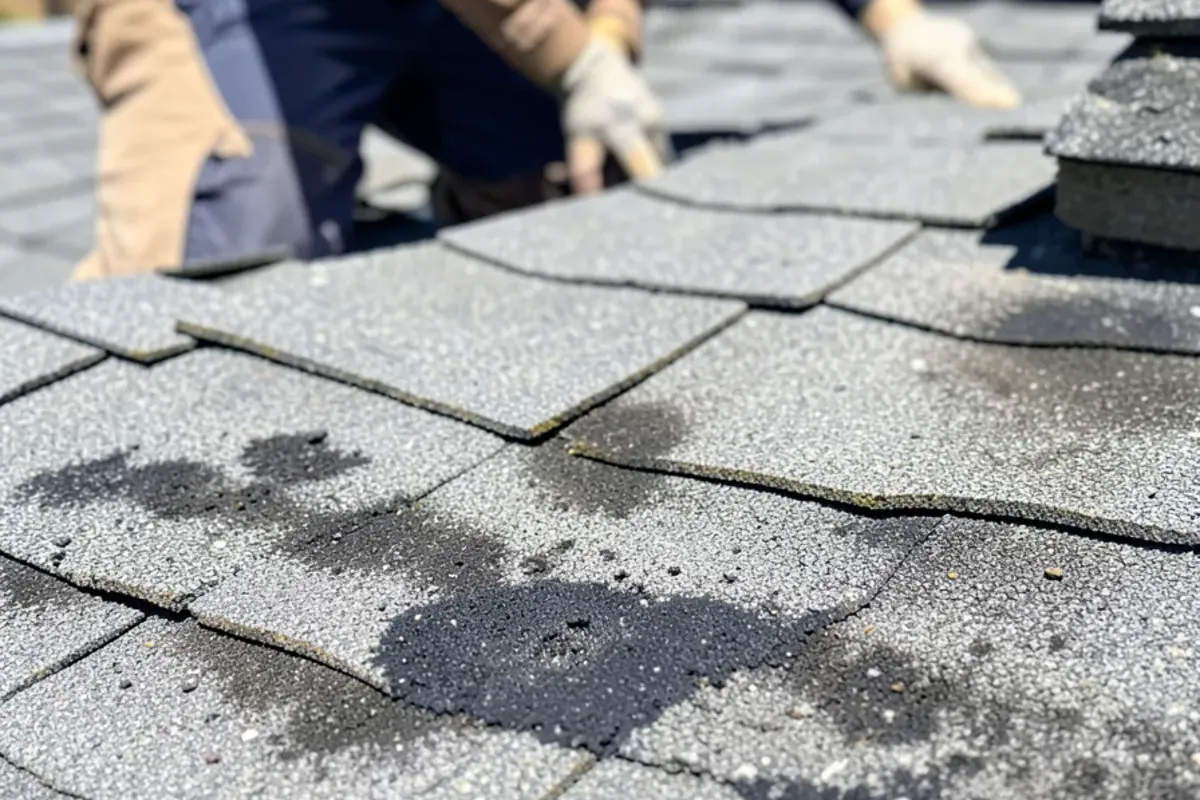
- Bald patches. Dark, smooth spots where black asphalt shows through.
- A visible fiberglass mat. If you can see the mesh, the shingle is past saving.
- Uneven color. One slope is much lighter or darker than another.
- Cracking and curling at the same time. Granule loss with cracking tabs means the shingle is brittle.
How does age loss differ from hail loss?
The pattern gives it away.
| Cause | Pattern on the roof | Other signs |
|---|---|---|
| Age and sun | Even wear, worst on south and west slopes | Curling, cracking, faded color |
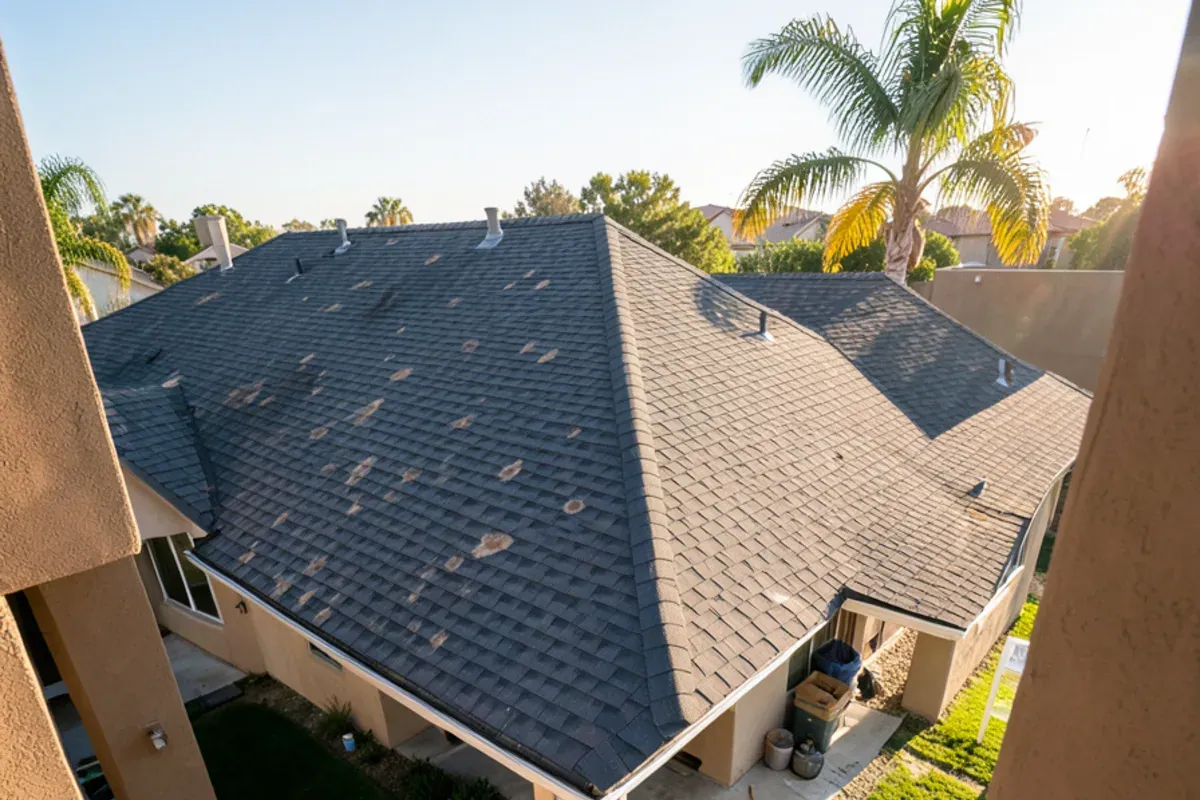
| Hail | Random round spots across all slopes | Bruising, soft spots, dents in vents and gutters |
| Foot traffic or tools | Linear scuffs along a path | Bald lines near ladders or equipment |
| Poor ventilation | Heavy loss with curling on upper slopes | Hot attic, blistered shingles |
Hail is uncommon in the South Bay but it happens. One Google reviewer described a roofer going through their neighborhood after a storm with scattered hail and strong wind, then showing clear photos of the hail marks, wind damage and a few missing shingles. For more on hail marks, see our guide to spotting real roof hail damage.
How much granule loss is too much?
This quick table pairs what you see with what it usually means.
| What you see | What it usually means | Common next step |
|---|---|---|
| Light dusting, new roof | Loose surplus granules settling | Watch it for a few months |
| Light dusting, older roof | Normal weathering | Check again after storms |
| Thick layer at every downspout | Shingles shedding faster than normal | Have the slopes inspected |
| Bald patches on the sunny slope | UV wear, shingle near end of life | Plan repair or a replacement budget |
| Random round bald spots with bruising | Possible hail | Photograph and have it inspected |
| Exposed fiberglass mat | Past saving | Replace the shingles involved |
A new roof that is still shedding heavily several months after installation, or that shows bald spots, is worth raising with the installer and the manufacturer. Keep your photos and dates.
Can you fix granule loss, or only live with it?
Granules cannot be restored, so repair means replacing the affected shingles. A few bare or bruised shingles on a roof that is otherwise sound can be swapped out. If bare patches cover a large part of a slope, the shingles are near the end of their life, and patching them often costs more than it saves.
Published 2026 cost guides put roof repairs at roughly $300 to $1,500, and asphalt roofing installed at $5 to $8 per square foot (HomeBlue, 2026). Those are market figures, not a quote. They show why the first step is a clear read of how much of the roof is affected.
Do spray-on products or coatings fix bare shingles?
Some products are sold to darken bald spots or to seal an aging shingle roof. They can improve the look for a while. They do not rebuild the granule layer, and they do not stop the asphalt below from aging. Before you pay for one, ask what it is, how long it lasts on a roof like yours, whether it affects the shingle manufacturer's warranty and whether it is meant for shingles or for a flat roof. For a roof with only a few bare spots, replacing those shingles is usually the cleaner repair. If the whole roof is bare, no surface product turns it back into a new roof.
Does granule loss from hail matter for an insurance claim?
It can, if hail was the cause. Policies generally cover sudden events and exclude ordinary wear, so a roof that is simply old is a maintenance matter. If you think hail did it, photograph the roof and the gutters and look for dents in metal vents and gutter ends. We document damage with photos and can be on site for the insurance adjuster's inspection, but we do not advise on coverage. In California only the policyholder or a public adjuster with the proper license negotiates a claim. Our post on how to file a roof insurance claim in California explains the steps, and our hail damage roof repair page covers the repair side.
Why do Southern California roofs lose granules?
Ultraviolet exposure is the main driver. Southern California gets strong sun for much of the year, and a dark asphalt roof soaks it up. Heat cycles each day flex the shingle, and the bond holding granules in the asphalt loosens. Poor attic ventilation speeds it by cooking the shingle from underneath. Foot traffic from gutter cleaners, satellite installers and solar crews knocks granules off along their path.
Torrance sits near the coast and gets about 14 inches of rain a year, so the rinse that carries granules into the gutter happens in a short season from November through March. Check the gutter after the first big storm and again in spring.
What roofers tell customers about granules
- Dig through the gutter, then look up. The pile tells us roughly how fast the roof is shedding.
- Compare slopes. The sun side usually shows the most loss. If the north slope is just as bad, something else is going on.
- Photograph the bare patches. We show you photos of what we find, so you decide with the evidence in front of you.
- Repair first. A repair comes first when a repair will do, and we do not push a replacement.
Deciding what to do about granules in the gutter
Scoop a handful from the gutter, photograph it and look at the roof from the ground in daylight for bald spots. A free roof inspection from a local roofing contractor in Torrance can examine the shingles up close, tell you whether you have normal wear, hail marks or a failing roof and lay out a repair or a plan for the years ahead.